
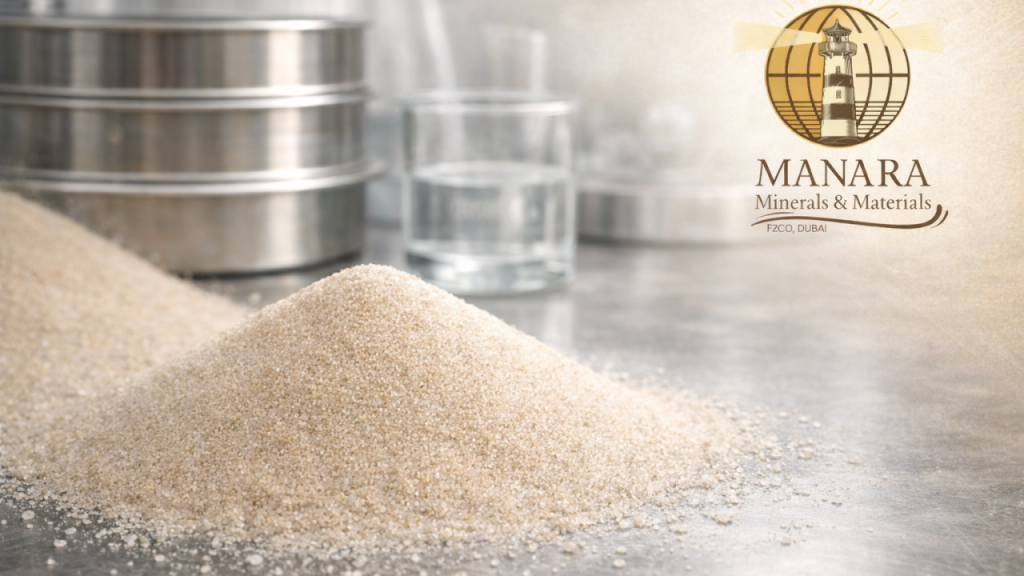
When industrial suppliers advertise “99% SiO₂ silica sand”, what does that actually mean?
Is 99% always good enough? Is 99.5% significantly better? And when does purity really matter?
For engineers, procurement managers, and industrial buyers in Saudi Arabia, UAE, and global markets, understanding silica purity is critical — because not all “99%” materials perform the same.
This guide explains silica purity in simple, practical, and technical terms.
What Is SiO₂?
Silicon dioxide (SiO₂) is the chemical compound that makes up silica sand. It consists of silicon and oxygen atoms and is one of the most abundant minerals on earth.
High-quality silica sand is composed mostly of SiO₂, with small amounts of other minerals such as:
- Iron oxide (Fe₂O₃)
- Aluminum oxide (Al₂O₃)
- Calcium oxide (CaO)
- Magnesium oxide (MgO)
- Clay and organic matter
The percentage of SiO₂ determines purity.
What Does 99% SiO₂ Actually Mean?
When a lab report states:
SiO₂ = 99%
It means that 99% of the material is pure silicon dioxide. The remaining 1% consists of impurities.
But here’s the important part:
That 1% can significantly impact performance depending on your industry.
Why the Remaining 1% Matters
Even small impurity levels can affect:

In industries like glass manufacturing, even 0.1% iron difference can change product color.
In filtration media, clay contamination reduces water flow efficiency.
In construction, excessive fines reduce strength.
Is 99% Always Good Enough?
It depends on the application.
Construction Industry
99% is usually sufficient for:
- Concrete production
- Tile adhesives
- Mortar mixes
- Construction chemicals
Consistency and grading often matter more than ultra-high purity.
Water Filtration
Filtration sand requires:
- Proper grain size distribution
- Low turbidity
- Controlled clay content
- Compliance with standards like ANSI/AWWA B100
Purity matters, but grading and washing quality matter just as much.
Glass Manufacturing
This industry may require:
- 99.5% – 99.8% SiO₂
- Extremely low iron content
Here, “99%” may not be sufficient.
Oil & Gas (Frac Sand)
Frac sand requires:
- High purity (often >99%)
- High crush resistance
- Round grain shape
Purity alone is not the only factor — mechanical strength matters too.
99% vs 99.5% – Is the Difference Significant?
Numerically, the difference is 0.5%.
Technically, it can mean:
- Lower iron content
- Lower contamination
- Higher processing cost
- Better suitability for high-end applications
However, price increases significantly with higher purity levels.
This is why procurement teams must match purity to application — not over-specify unnecessarily.
How to Verify Silica Purity
Always request:
✔ Chemical Analysis Report ✔ Sieve Analysis Report ✔ Moisture Content Test ✔ Iron Content Breakdown
Reputable suppliers provide certified lab results with each batch.
Common Misconceptions About 99% Silica
Myth 1: 99% means premium quality. → Not always. Washing, grading, and consistency matter too.
Myth 2: Higher purity always improves performance. → Only in specific industries.
Myth 3: All 99% sand is the same. → Source geology and processing method create differences.
Practical Buying Advice for Industrial Buyers
Before purchasing silica sand ask,
What is the exact Fe₂O₃ percentage?
- What is the grain size distribution?
- Is the sand washed and dried?
- Is it compliant with required standards?
- What is the moisture content at delivery?
These questions reduce risk and prevent costly project issues.
Final Takeaway
“99% SiO₂” is a strong starting point — but it is not the full story.
True material quality depends on:
- Purity
- Grain size consistency
- Impurity type
- Processing method
- Application suitability
For industrial buyers, understanding these differences leads to better procurement decisions, cost optimization, and long-term project performance.
If you found this useful, the next issue will cover:
👉 Mesh vs Micron: A Simple Technical Guide for Industrial Buyers
📞 Contact us today for specifications and supply
📲 Whatsapp: wa.me/+971 58 991 9363
📱 Call: +971 55 750 2255
📩 Email: info@manaraminerals.ae
🌐 Website: www.manaraminerals.ae
📍 Dubai, UAE